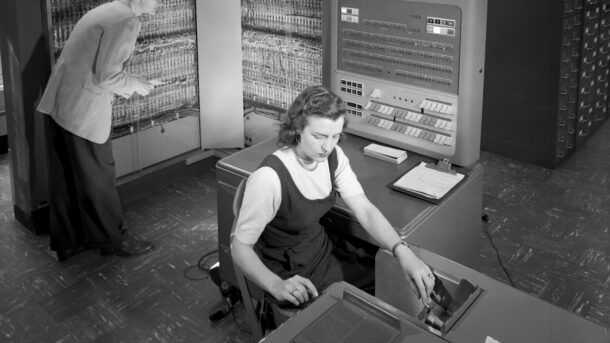
On September 20, 1954, the first FORTRAN program ran successfully on an IBM 704 computer, marking the debut of what would become the world’s oldest surviving high-level programming language still in active use today.
FORTRAN — short for “FORmula TRANslation” — was the brainchild of a team at IBM led by John Backus. Before it existed, programmers wrote instructions in tedious machine or assembly code, translating math by hand into strings of numeric operations. FORTRAN let them write something much closer to ordinary algebra, and a compiler handled turning it into machine instructions. That first successful run in 1954 came a full three years before IBM shipped its production FORTRAN compiler in April 1957, but it proved the underlying idea worked. The language went on to become the workhorse of scientific and engineering computing for decades, and specialized descendants of it are still used today in fields like weather modeling and physics simulations.
It’s easy to underrate how radical this was at the time: it meant a scientist, not just a specialist machine operator, could reasonably expect to write software. That shift — from hand-coding hardware instructions to writing in something resembling human notation — set the template that essentially every programming language since has followed.
Also on this day: in 1983, the U.S. Patent Office issued the patent for the RSA encryption algorithm, nearly six years after Ron Rivest, Adi Shamir, and Leonard Adleman first published it — the delay was tied to national security concerns over releasing the underlying math.
Source: Computer History Museum, EDN
Daily Tech History is a running series looking back at notable moments in technology on this date.