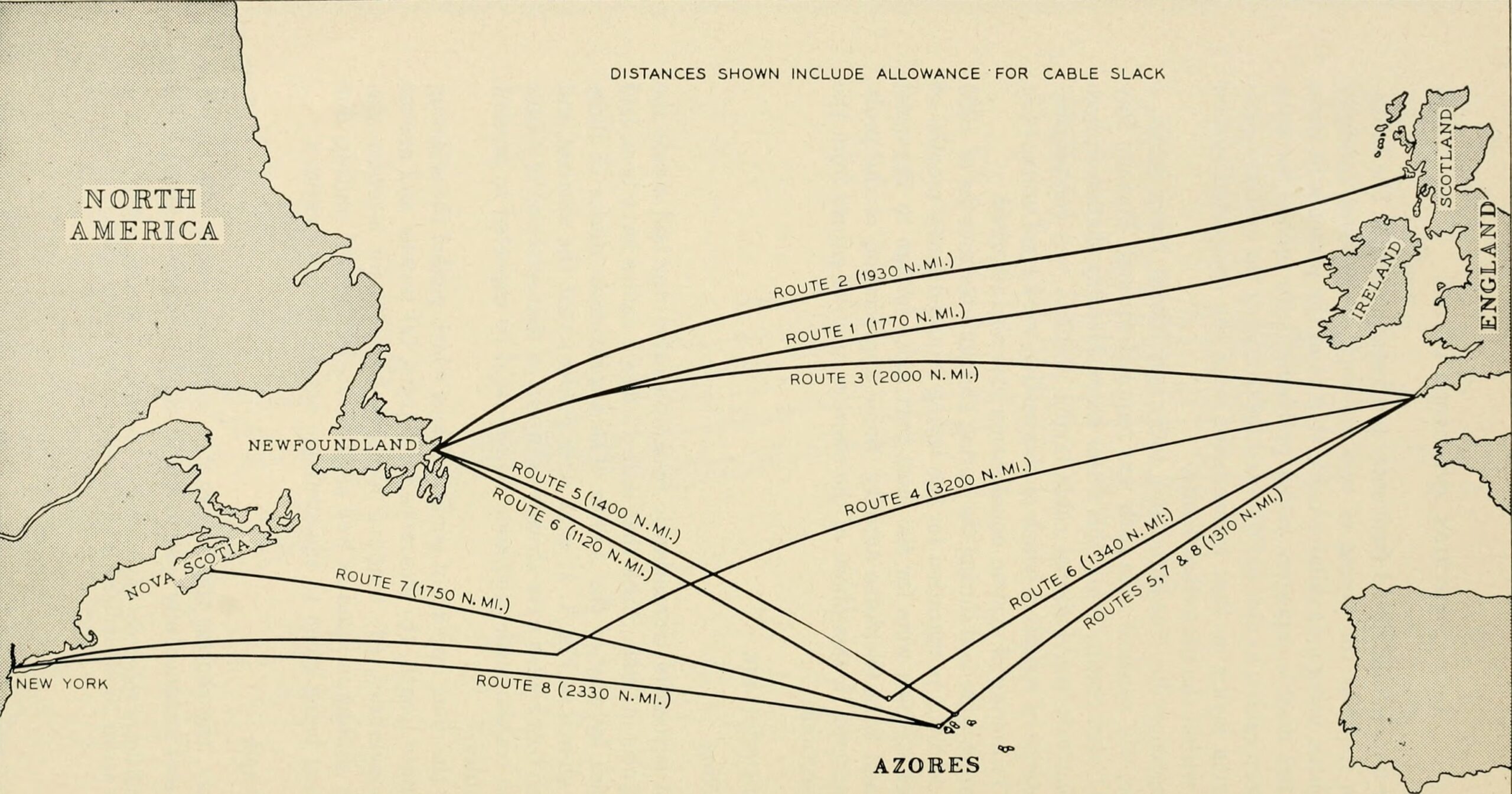
On September 25, 1956, TAT-1, the first telephone cable laid across the Atlantic, opened for public service. At a ceremony at Lancaster House in London, Britain’s Postmaster General opened the line by talking live with the chairman of AT&T in New York and with Canada’s Minister of Transport. The system was built jointly by Bell Telephone Laboratories, AT&T and the British Post Office. It ran about 1,950 nautical miles from Oban, Scotland, to Clarenville, Newfoundland, then connected overland to Montreal and New York.
Before TAT-1, a transatlantic phone call went out over shortwave radio. That service dated to 1927, and it was expensive, fragile and at the mercy of atmospheric conditions. The new cable carried about 36 voice channels: 29 between London and New York, 6 between London and Montreal, and one shared by telegraph traffic. That sounds tiny now, but people clearly wanted it. In its first 24 hours the cable handled 588 calls between London and the U.S. and 119 between London and Canada. The hard engineering was in the 51 repeaters spliced into each of the two cables (one for each direction) about every 37 miles. Every one of them was vacuum-tube electronics sitting on the ocean floor, and the tubes famously never failed during the system’s 22 years of service.
A Cold War footnote: Starting in 1963, TAT-1 also carried the Moscow–Washington hotline, which used teleprinter messages rather than voice because written text was seen as less likely to be misread. The cable was retired in 1978. By then it had made submarine cables the backbone of international communications, and today’s fiber-optic transatlantic cables carry millions of times its capacity.
Source: IEEE Engineering and Technology History Wiki: TAT-1 Milestone
Source: Wikipedia: TAT-1
Daily Tech History is a running series looking back at notable moments in technology on this date.
Leave a Reply
You must be logged in to post a comment.