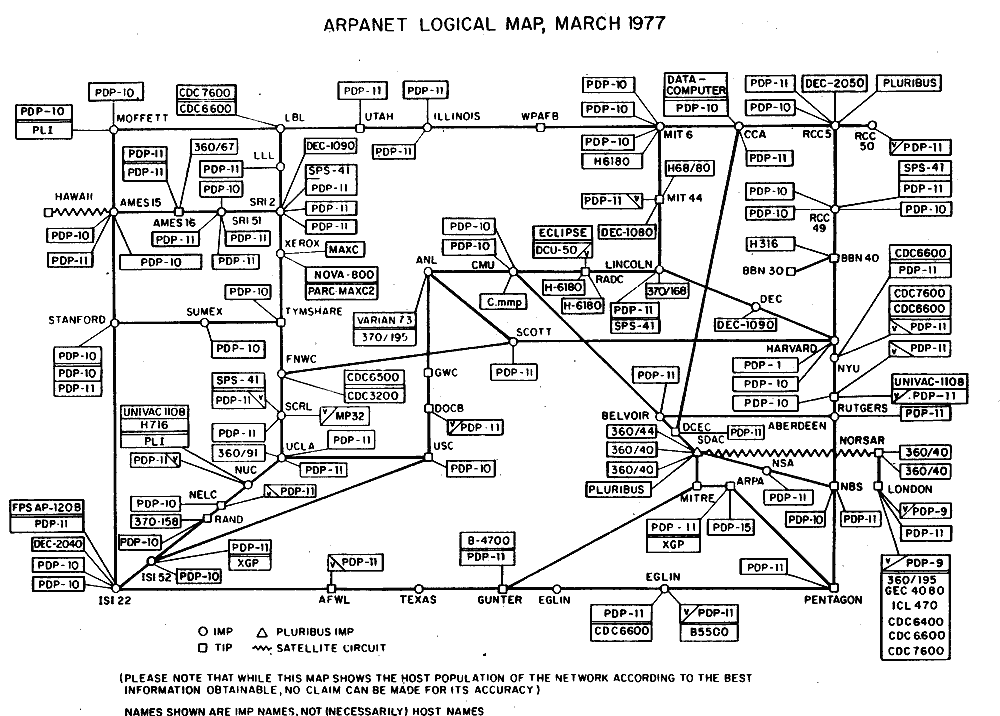
On October 27, 1980, the ARPANET — the Pentagon-funded network that would grow into the modern internet — suffered its first major network-wide crash, a roughly four-hour outage that took down the entire system. The trouble started with a hardware glitch in one of the network’s switching computers (an “IMP,” or Interface Message Processor), which began generating bad status packets. Other IMPs picked up the faulty data and rebroadcast it, and the garbled messages multiplied across the network faster than any single node could process them, choking the whole system in what engineers later called a “broadcast storm.”
It was a wake-up call for the small community running the early internet. The ARPANET had been live for over a decade by that point, but this was the first time a localized fault had cascaded into a total network failure — exposing just how fragile a system built from independent, trusting nodes could be. BBN engineer Eric Rosen’s technical write-up of the incident, RFC 789, became required reading for anyone designing network protocols, and the crash helped push the field toward building in more resilience against exactly this kind of runaway failure as ARPANET evolved into the modern, far more robust internet.
Also born on this day: Gerald Weinberg, in 1933 — a computer scientist and author whose 1971 book The Psychology of Computer Programming was one of the first to treat software development as a human and social activity rather than a purely technical one, influencing generations of thinking about how programming teams actually work.
Source: Computer History Museum, Motherboard/Vice
Daily Tech History is a running series looking back at notable moments in technology on this date.
Leave a Reply
You must be logged in to post a comment.