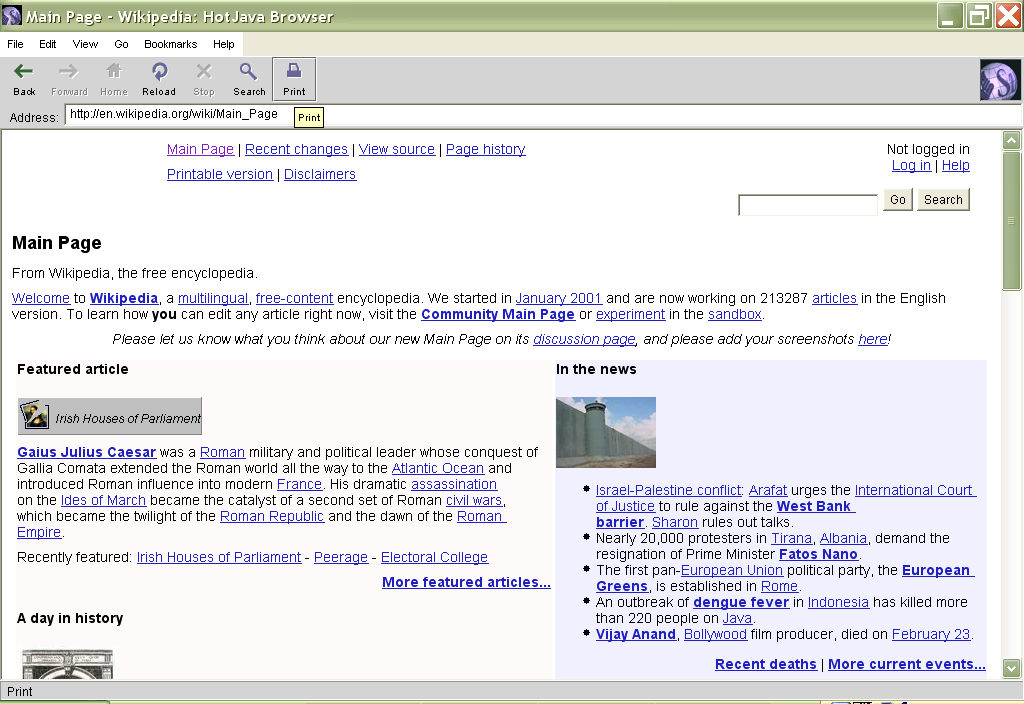
On September 29, 1994, a small team of Sun Microsystems programmers demonstrated something unusual to the company’s executives: a web browser that could run actual software, not just display pages. The prototype, originally built under the codename WebRunner as a clone of the popular Mosaic browser, was written in a new programming language the team had been quietly developing. That language would soon be renamed Java, and the browser built to show it off would become known as HotJava.
The idea behind HotJava was radical for its time: instead of a browser that just rendered static text and images, it could download and run small programs — Java applets — directly inside a web page. That meant animations, calculators, games, and interactive tools could live on a webpage and run the same way regardless of whether the visitor was on a Mac, a PC, or a Unix workstation. It took almost three more years for Sun to officially ship HotJava (it wasn’t released until March 1997), and by then Netscape and Internet Explorer had already built Java applet support into their own browsers, largely overtaking HotJava’s original purpose. But that internal demo in September 1994 was the moment Java’s promise of “write once, run anywhere” first got shown off on the web, setting the stage for a language that would go on to power everything from enterprise servers to Android phones.
HotJava itself never became a mainstream browser — it was often criticized as sluggish, a side effect of running on the still-young Java virtual machine — and Sun quietly discontinued it in 2004. But its legacy stuck around in an unexpected way: the browser’s HTML parsing code was later folded into Java’s standard libraries, where pieces of it lived on for years.
Source: Computer History Museum and Wikipedia
Daily Tech History is a running series looking back at notable moments in technology on this date.
Leave a Reply
You must be logged in to post a comment.