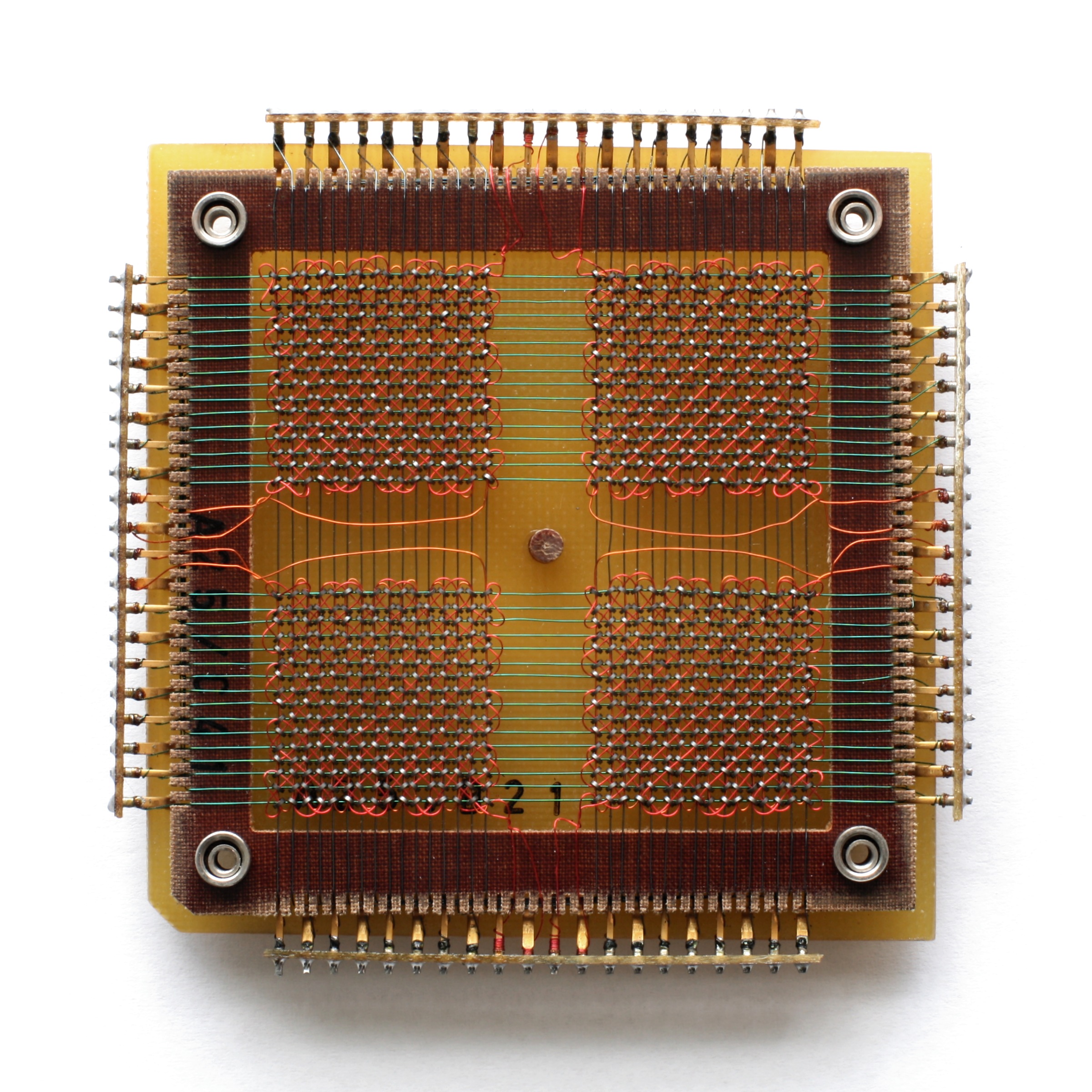
On October 21, 1949, An Wang filed a patent for what he called “pulse transfer controlling devices” — the invention now known as magnetic-core memory. Working with a Harvard colleague, Way-Dong Woo, Wang had figured out how to use tiny rings of magnetic ferrite to store a single bit of data, reliably and without any moving parts.
Before core memory, computer memory mostly meant mercury delay lines, rotating magnetic drums, or fragile vacuum-tube storage, all of which were slow, bulky, or prone to failure. Magnetic cores solved that: each ring could be magnetized clockwise or counterclockwise to represent a 0 or a 1, read without erasing the data, and wired together into dense grids that scaled up far more cleanly than anything that came before. Wang’s patent was granted in 1955, and he later sold the rights to IBM for a reported $500,000, a deal that helped fund the company he’d go on to build, Wang Laboratories.
Core memory became the dominant form of computer memory for roughly two decades, powering everything from mainframes to the Apollo Guidance Computer, until semiconductor RAM finally displaced it in the 1970s. The phrase “core dump,” still used by programmers today to describe a memory snapshot after a crash, is a direct linguistic fossil of this technology, decades after the physical cores themselves disappeared from computers.
Source: Computer History Museum: This Day in History, Wikipedia: Magnetic-core Memory
Daily Tech History is a running series looking back at notable moments in technology on this date.
Leave a Reply
You must be logged in to post a comment.