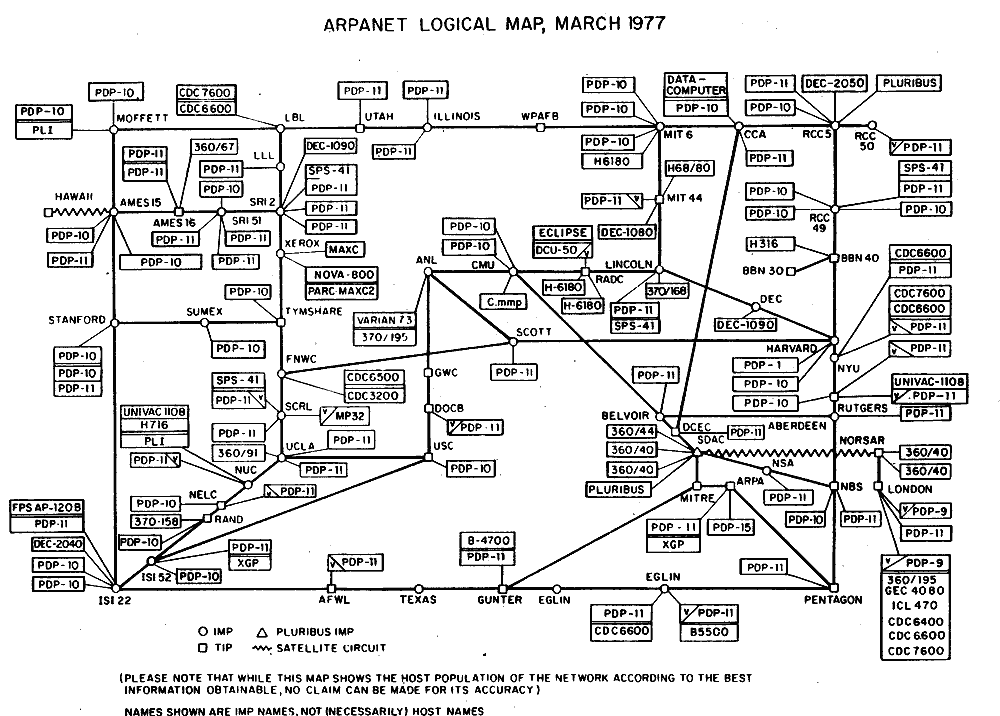
On October 29, 1969, a UCLA graduate student named Charley Kline sent the first message over ARPANET, the Pentagon-funded research network that would eventually grow into the modern internet. Working under computer science professor Leonard Kleinrock, Kline tried to type the word “login” to a computer at the Stanford Research Institute (SRI), roughly 350 miles away. The receiving system crashed after the first two letters arrived, so the actual first message ever transmitted across a wide-area computer network was simply “lo.” About an hour later, after the system was reset, the full word went through successfully.
The stumble was fitting for a technology still finding its footing. ARPANET connected just two nodes that night — UCLA and SRI — using the packet-switching ideas Kleinrock had been developing, which broke data into small chunks that could be routed independently rather than sent over a single dedicated circuit. By the end of 1969, two more nodes joined (UC Santa Barbara and the University of Utah), and the network kept expanding through the 1970s and 80s. The core idea of packet switching, proven out that night, became the foundation the entire internet still runs on today.
It’s worth remembering that ARPANET wasn’t built to be “the internet” — it was a practical experiment in letting geographically separated research computers share resources and data. The grander consequences, from email to the web, followed decades later as the underlying protocols were refined and opened up. But the crashed, half-finished “lo” of October 29, 1969, is as good a birthday as any for the age of networked computing.
Source: History.com, ICANN (Leonard Kleinrock’s account)
Daily Tech History is a running series looking back at notable moments in technology on this date.
Leave a Reply
You must be logged in to post a comment.