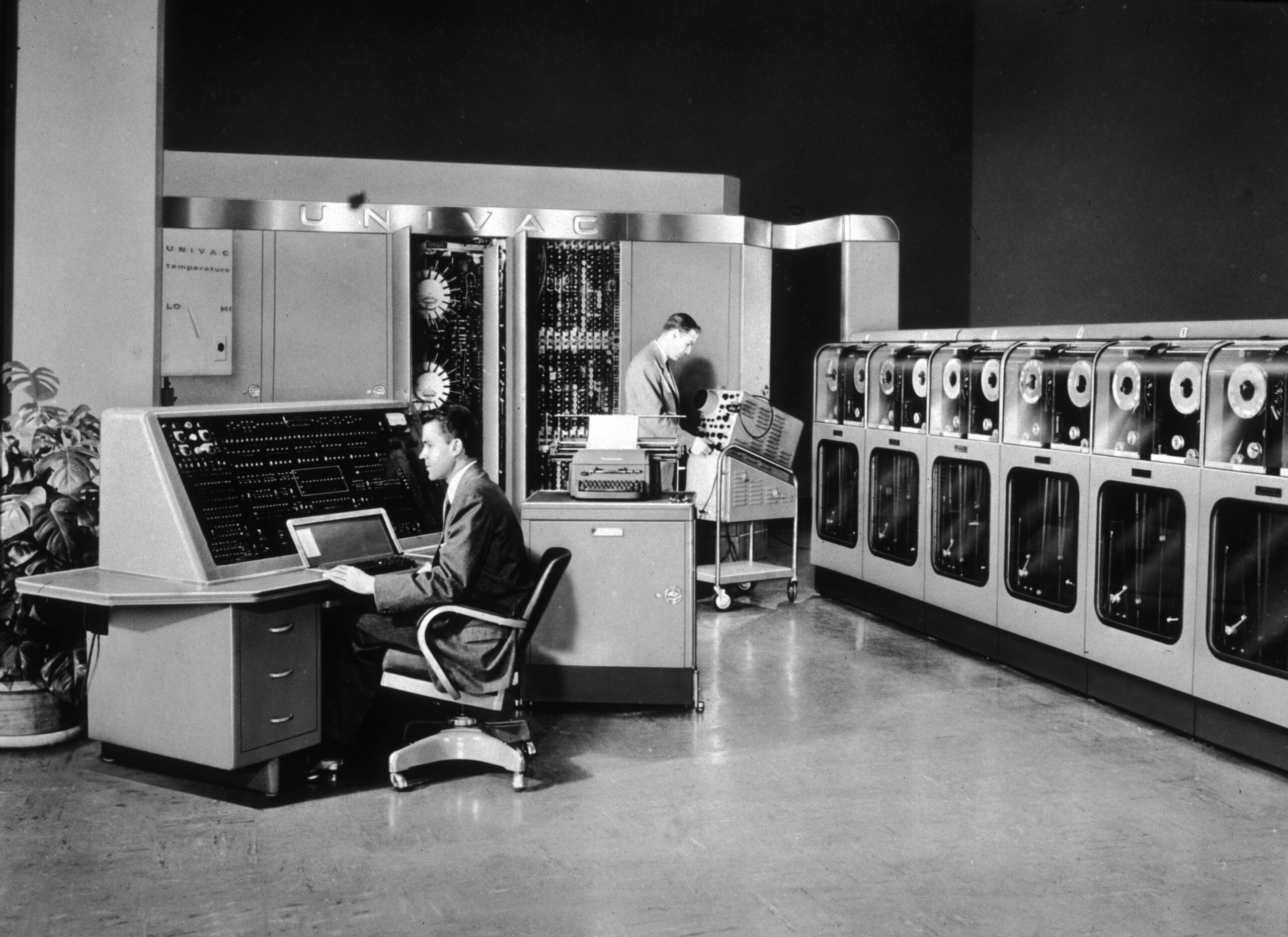
On November 4, 1952, a computer predicted a U.S. presidential election for the first time on live television — and the broadcasters almost didn’t believe it. CBS News had rented a UNIVAC I, the first commercially produced computer in the United States, to analyze early returns from the Eisenhower-Stevenson race as they came in. The machine itself sat in a Remington Rand factory in Philadelphia; what viewers saw on their screens, hosted by Walter Cronkite, was a mock-up terminal in a New York studio connected to it by teletype.
By around 9:15 p.m. Eastern, UNIVAC had crunched a handful of early state returns and spit out a startling forecast: Eisenhower would win in a landslide, with 438 electoral votes to Stevenson’s 93. That contradicted nearly every pre-election poll, which had called the race a toss-up, so the programmers and CBS executives got cold feet and held the prediction off the air. Later that night, after a data-entry error briefly swung the on-screen projection back toward a nail-biter, the mistake was caught and corrected — and the original landslide call turned out to be almost dead-on. When the real results came in matching UNIVAC’s early math, CBS had to publicly admit the computer had been right all along and they’d sat on it.
The stunt made UNIVAC a household name almost overnight, at a time when “computer” was still a word most Americans had never heard applied to a machine. It also set the template for something now completely ordinary: networks racing to call elections with statistical models long before all the votes are counted. Four years later, in 1956, all three major networks were using computers for election-night predictions.
Source: Computer History Museum, Engineering and Technology History Wiki (ETHW)
Daily Tech History is a running series looking back at notable moments in technology on this date.
Leave a Reply
You must be logged in to post a comment.