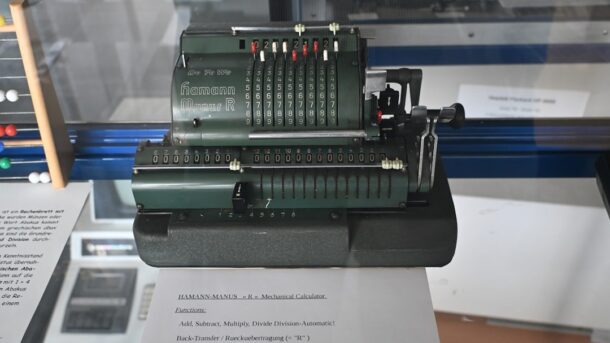
On August 21, 1888, William Seward Burroughs was awarded four U.S. patents (Nos. 388,116–388,119) for his “calculating machine” — the device that became the first commercially successful adding machine in America. Burroughs, a former bank clerk in Auburn, New York, had grown frustrated watching coworkers grind through hours of manual arithmetic each day, often with mistakes that had to be caught and redone by hand. The existing adding machines of the era were unreliable, so he set out to build one that clerks could actually trust.
The patents, filed back in 1885, capped years of painstaking refinement — Burroughs reportedly worked out some of the mechanical drawings under a microscope to get the tolerances right. A year earlier, in 1886, he had already founded the American Arithmometer Company to bring the machine to market, and within about a year of the patent grant the company had produced around 50 units. The design later paired the calculator with a printer, giving clerks a paper record of every calculation — an innovation that earned Burroughs the Franklin Institute’s John Scott Legacy Medal in 1897.
Burroughs didn’t live to see how far his invention would go — he died in 1898 — but the company he started kept growing. It was renamed the Burroughs Adding Machine Company in 1904, became the Burroughs Corporation in 1953, and in 1986 merged with Sperry Corporation to form Unisys, a company still in business today. It’s a reminder that a lot of modern computing’s corporate lineage traces back to unglamorous 19th-century office equipment built to stop clerks from double-checking their own arithmetic.
Source: EDN — “Burroughs receives calculating machine patents, August 21, 1888”
Daily Tech History is a running series looking back at notable moments in technology on this date.