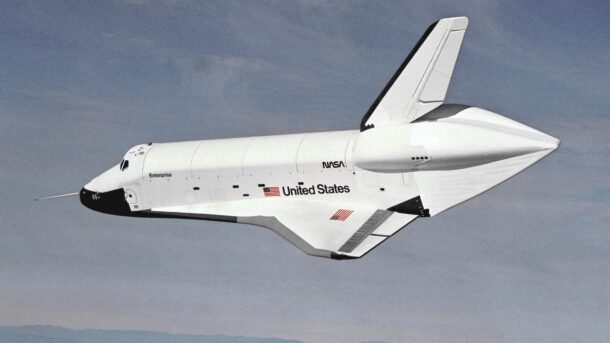
On September 17, 1976, NASA rolled out its first space shuttle orbiter, Enterprise, at a public ceremony in Palmdale, California — the debut of the vehicle that would spend the next few years proving the shuttle program’s basic aerodynamics before a single shuttle ever reached orbit.
Enterprise never flew in space. It had no engines and no functional heat shield, and it was never meant to — its job was atmospheric drop tests, gliding back to a runway after being released from a modified Boeing 747, to validate that the orbiter design could actually fly and land like a plane. The real orbital debut came a few years later with Columbia. But Enterprise’s rollout was the moment the shuttle program stopped being blueprints and became hardware, and it’s arguably the more famous of the two thanks to its name: NASA had originally planned to call it Constitution, until a write-in campaign from Star Trek fans convinced the Ford administration to rename it after the show’s starship. Several of the show’s cast turned up for the ceremony.
The shuttle program that Enterprise kicked off would go on to fly 135 missions over three decades, and its influence — reusable spacecraft, a runway landing, cargo-bay-sized payloads — still shapes how engineers think about crewed spaceflight today.
Daily Tech History is a running series looking back at notable moments in technology on this date.